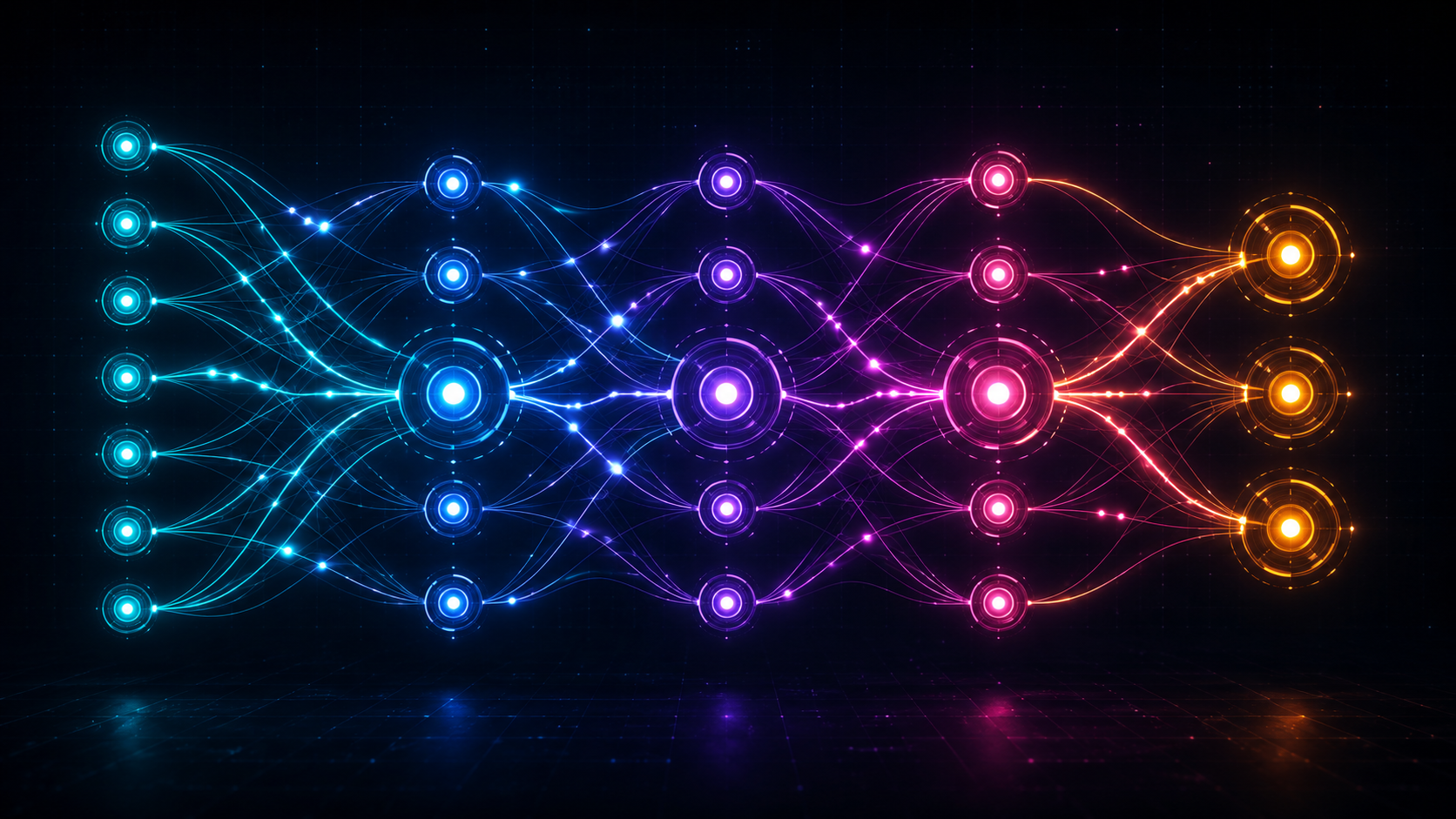
Learn deep learning through interactive architecture, mechanism, and training visualizations.
Live Architecture Preview3D structure · 2D diagram · signal flow
Active LayerHidden 02
Signal FlowInput → Latent → Output
Loss Curve
Update Stepθ ← θ - η∇L
Suggested Curriculum
Follow the model from structure to learning
Six focused modules move from network anatomy to the math of one update. Each stage opens the matching lab and gives you a concrete thing to inspect before moving on.
6 stagesArchitecture -> Mechanisms -> Training
Simulation
Step0
Epoch0
Network Type
Architecture Parameters
MLP Parameters
Performance
ArchitectureMLP
Camera Controls
Q
W
E
A
S
D
Z
X
C
Last action: Ready
Guidance
Legend
Input / source data
Hidden processing
Output / decision
Latent / gates / memory
Moving particles show signal flow
Lines show weighted connections
Activation Lab
ReLU
f(x)0.00
f'(x)0.00
Optimization Lab
Loss Surface Descent
Loss0.000
Gradient0.000
Step0
Loss Lab
Mean Squared Error
Loss0.123
Slope0.000
ObjectiveMinimize
Mechanisms Lab
Diffusion
FamilyGenerative models
Core IdeaNoise to sample
Diffusion Denoising
Follow the complete diffusion mechanism: add noise during training, start generation from noise, predict removable noise, step the scheduler, and reveal the final sample.
MLP Training Tutorial
End-to-End Learning Cycle
Step 01: Data Enters
One labeled example enters the network. The feature vector becomes the visible starting signal, while the target waits at the end as the answer the model should move toward.
Formula CalloutWeighted Sum
z = Wx + b
Mechanism Atlas
Choose Mechanism
Grouped by how each mechanism shapes information flow, stability, spatial processing, and sequence context.
Filter Category
No matching mechanisms.
Network Atlas
Choose Architecture
Select the neural system to render in the lab. Architectures are grouped by how they process information.
Welcome to Neural Lab
Explore neural networks in an interactive 3D environment.